Press kit
Everything you need to write about The Student Founder or to book Andrew Ashur. For interviews, review copies, and campus talks, email andrewashur@gmail.com.
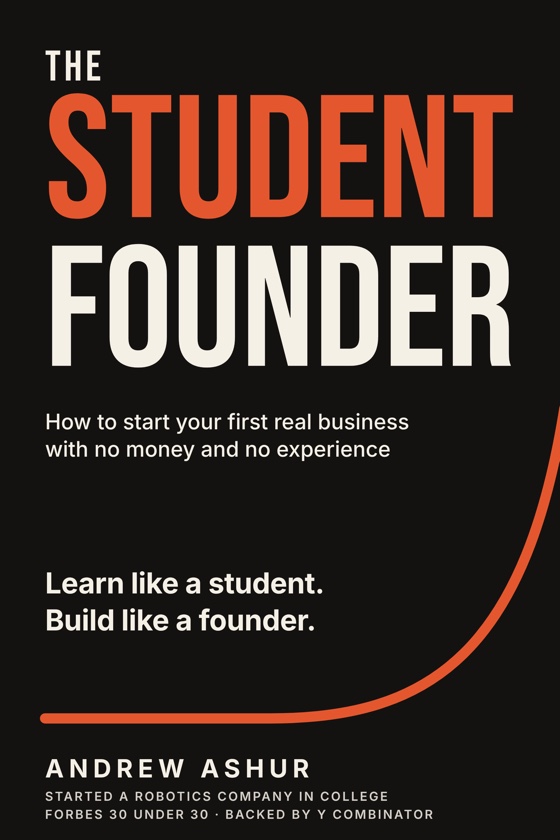
The book
- Title
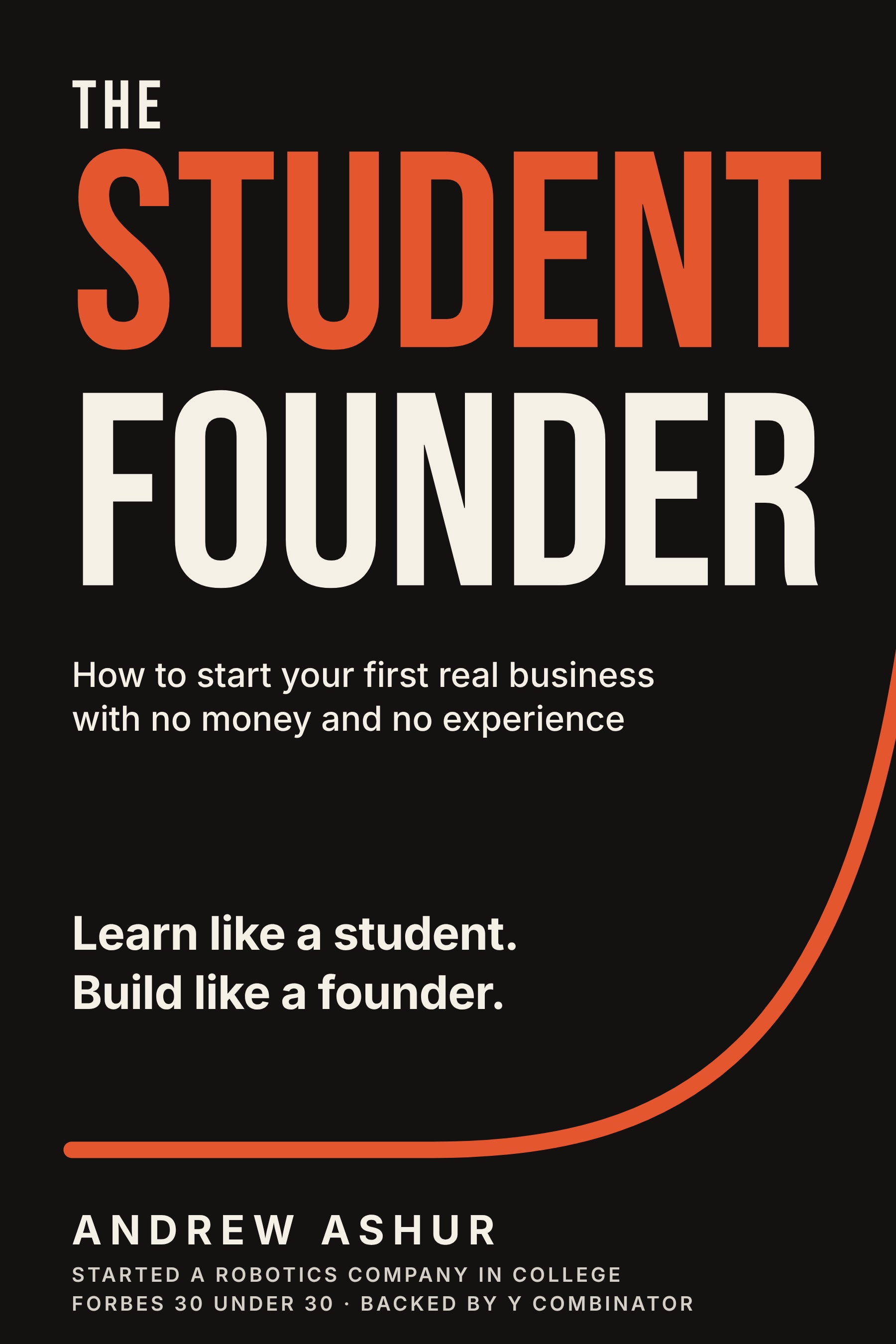
- The Student Founder
- Subtitle
- How to Start Your First Real Business with No Money and No Experience
- Author
- Andrew Ashur
- Publication
- February 23, 2027
- Publisher
- Student Founder Press
- Formats
- Paperback $19.95 · hardcover $28.95 · Kindle $9.99
- Size and length
- 6 × 9 in, about 290 pages
- ISBN
- 979-8-9829433-0-9 (paperback) · 979-8-9829433-1-6 (hardcover) · 979-8-9829433-2-3 (ebook)
- Category
- Business and entrepreneurship
- For
- High school and college students, recent graduates, and anyone starting a first business
The Student Founder is a practical manual for starting a first business with no money and no experience. It is written for students, because that is when trying costs the least, and the steps are the same for anyone starting a first business. It argues that what stands between you and your first paying customer is not experience. It is agency: seeing a problem, recognizing you have the free will to act on it, and going to learn whatever solving it requires. The book walks through finding a real problem, finding the time, getting customers before you build, building the first version, and a 30-day sprint that turns all of it into action.
Images
- Front coverJPG, 1800 × 2700
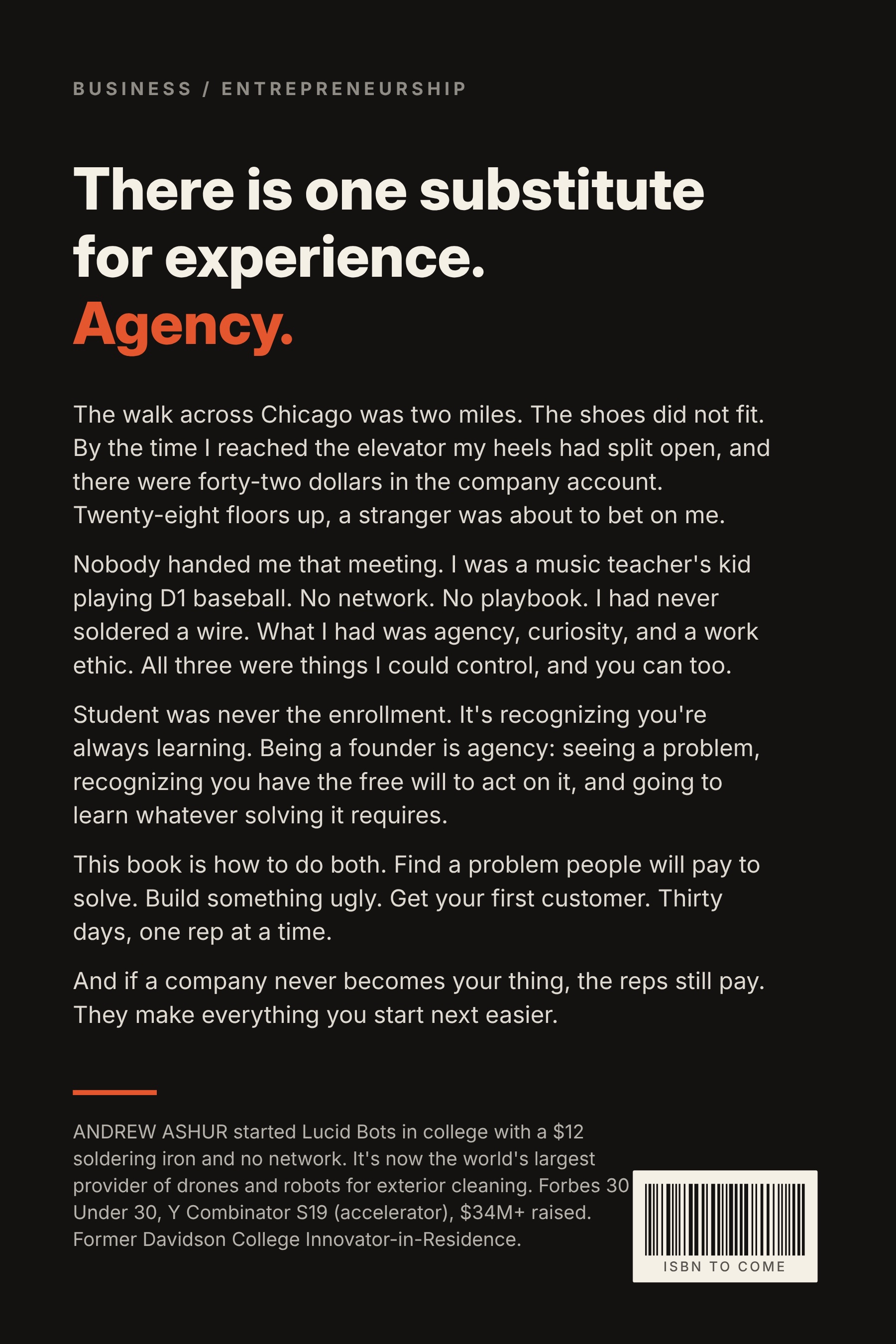
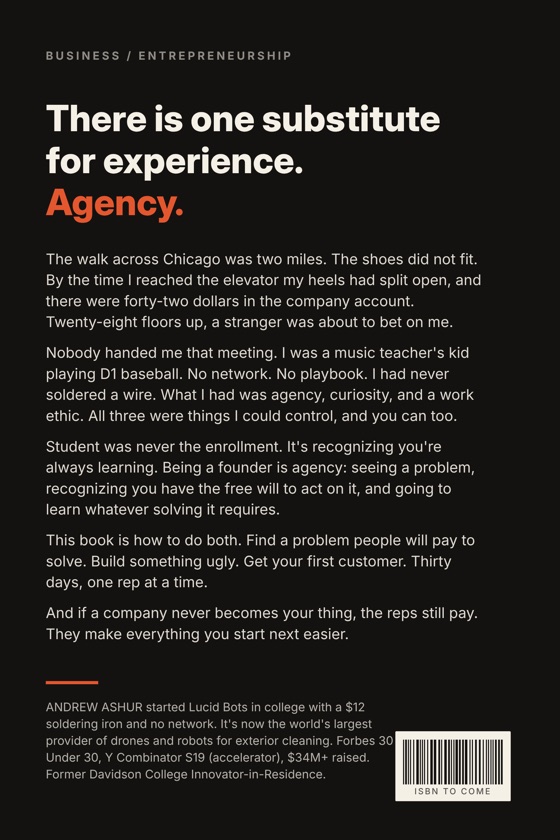 Back coverJPG, 1800 × 2700
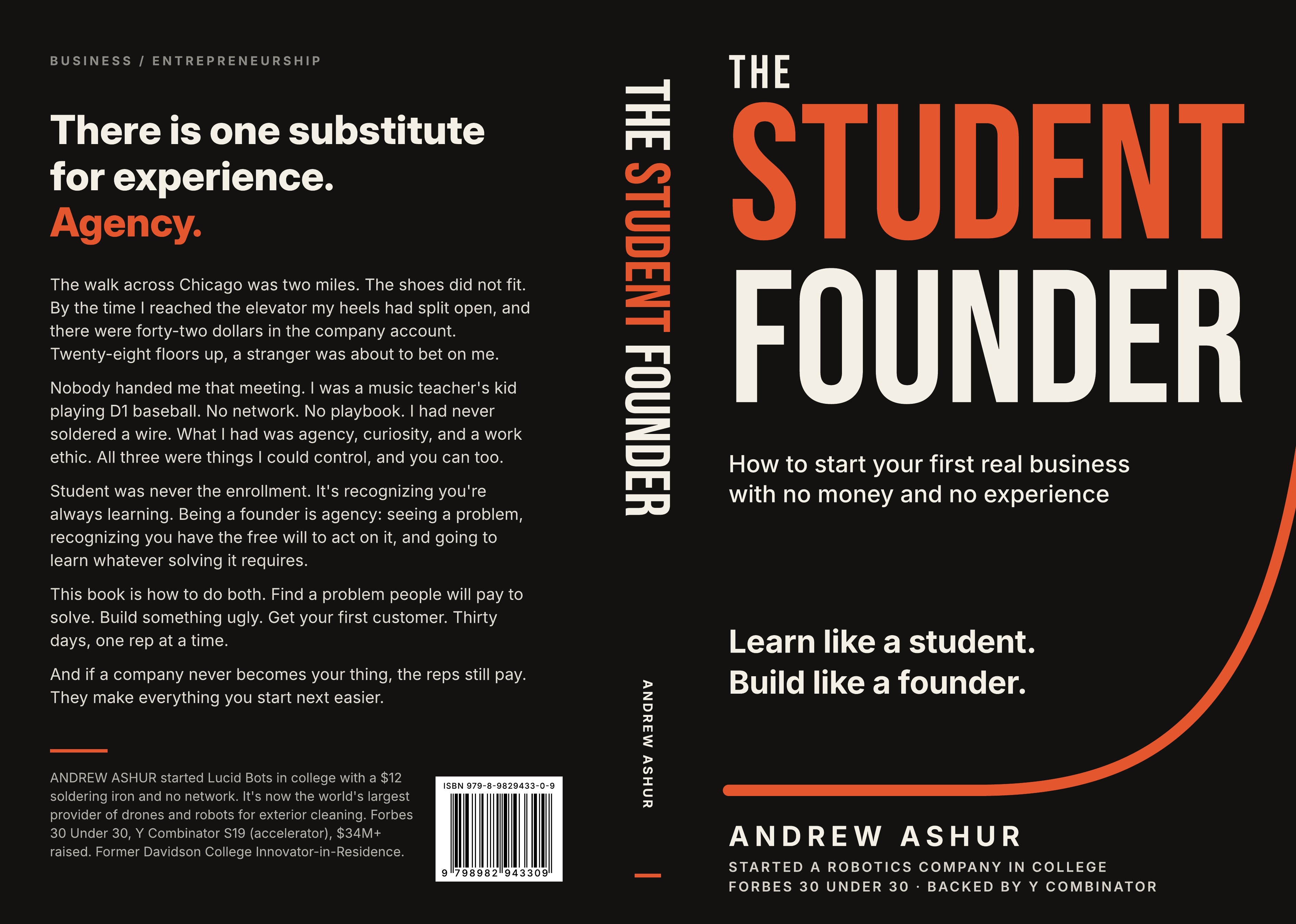
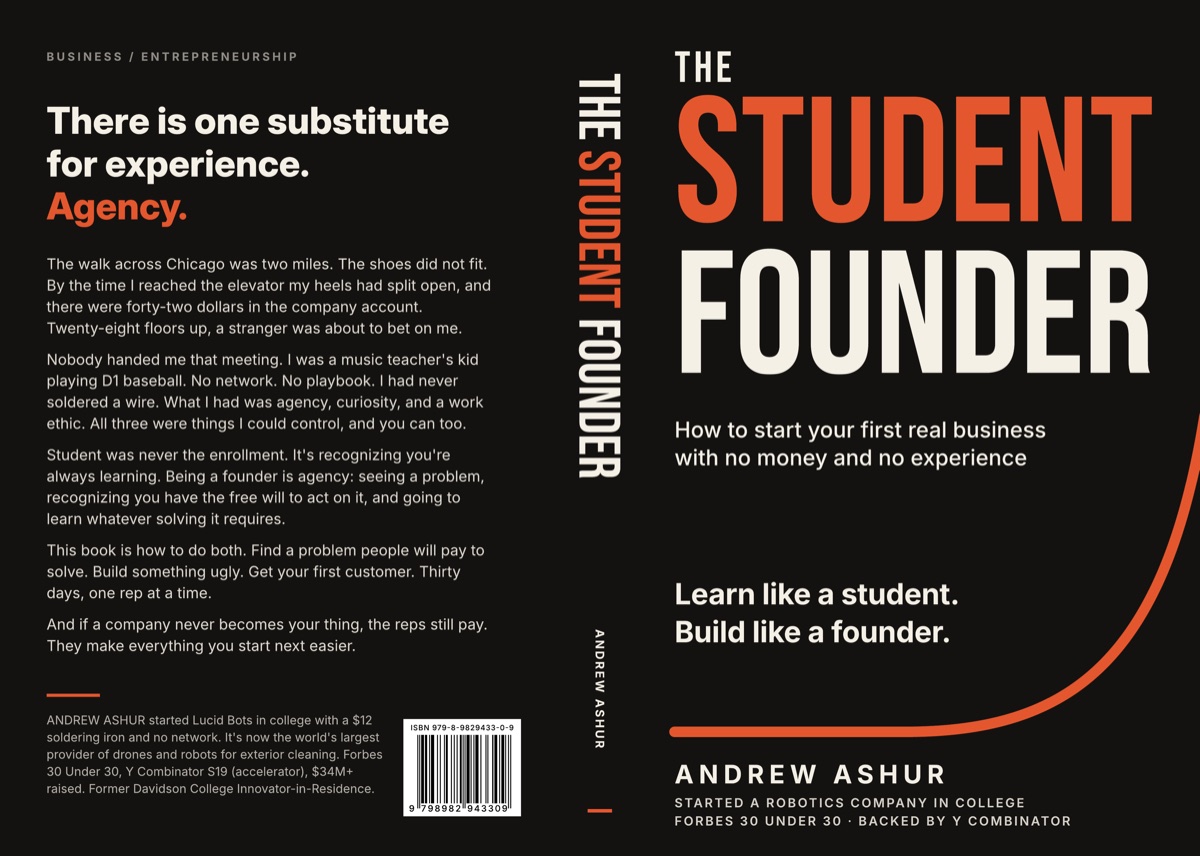 Full cover wrapJPG, 3785 × 2700
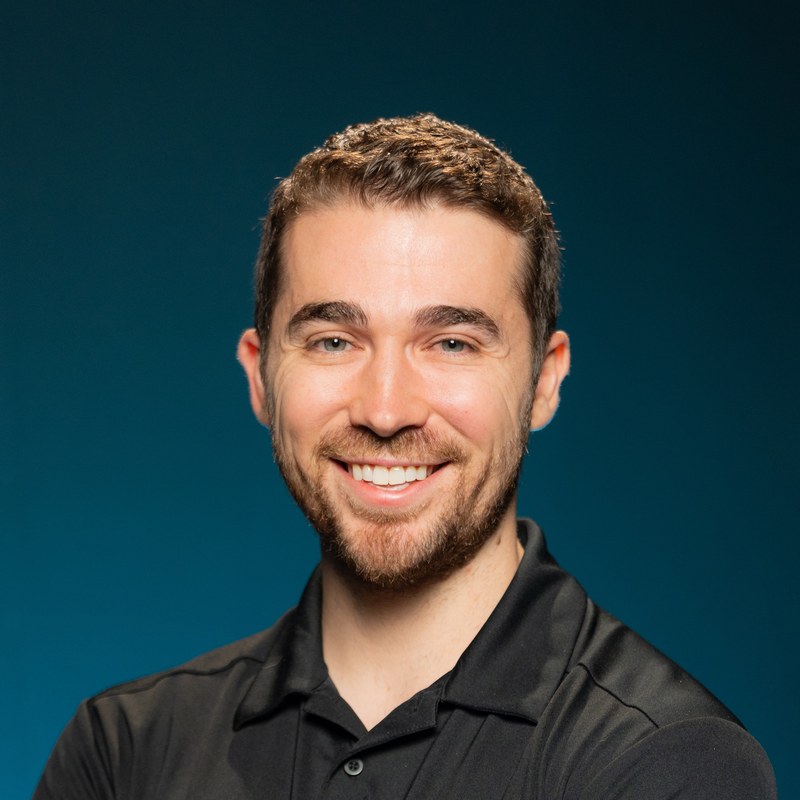 Author photoJPG, 800 × 800
- Chapter onePDF, 14 pages, free to share
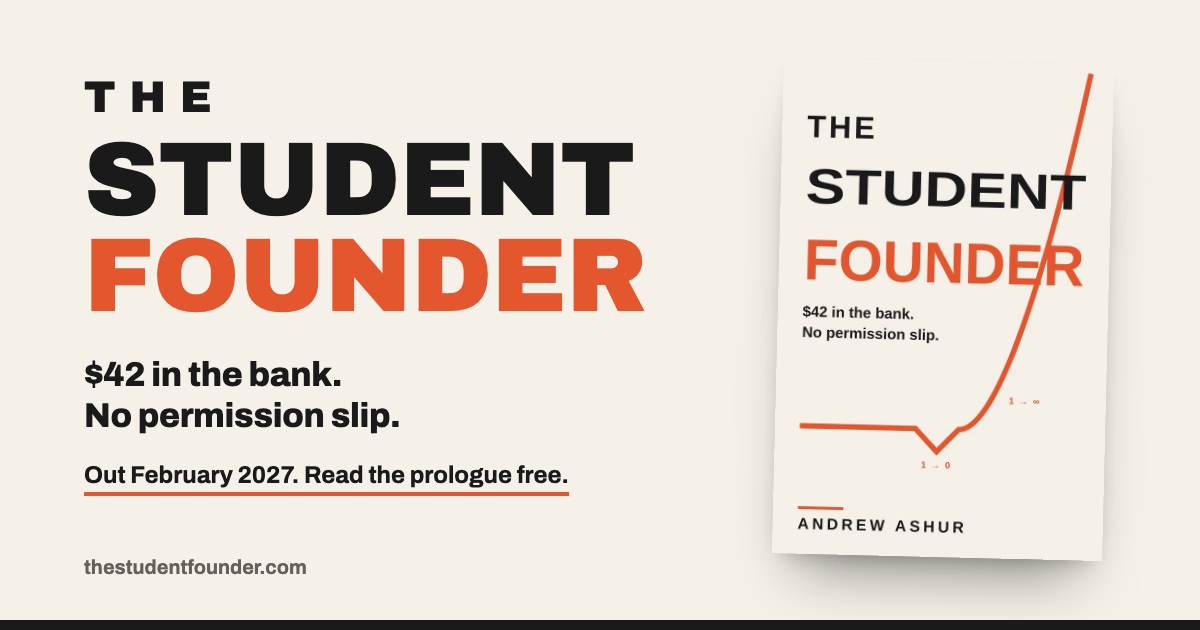 Announcement imageJPG, 1200 × 630
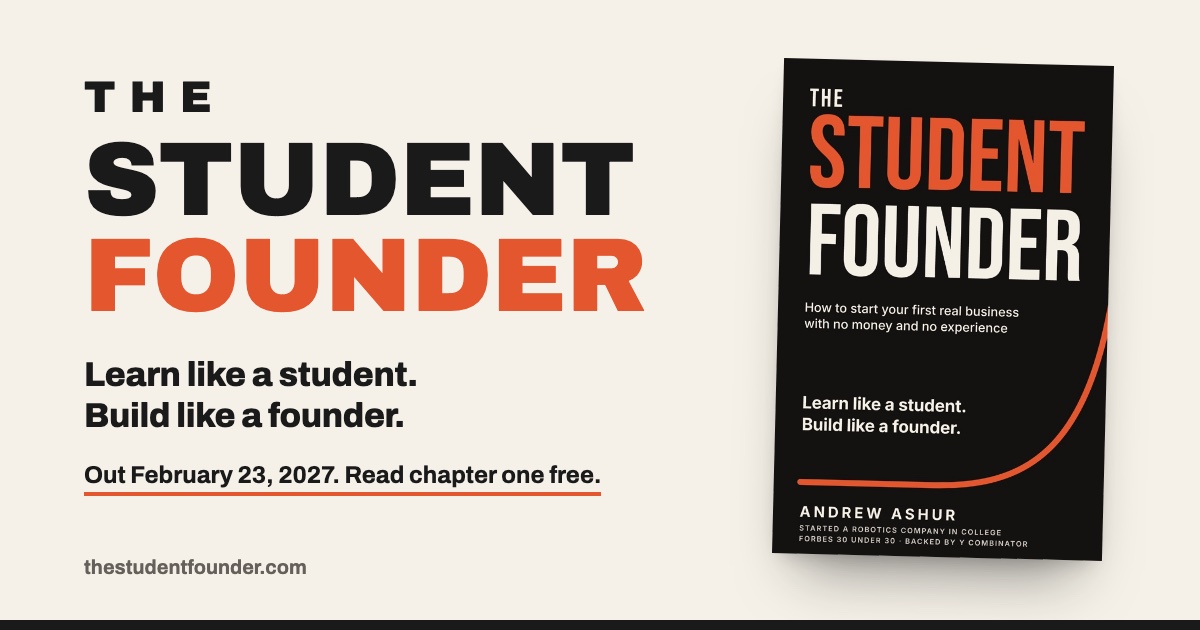
Open an image, then save it. Need a larger file or a different crop? Email andrewashur@gmail.com.
About the author
Short bio
Andrew Ashur is the founder and CEO of Lucid Bots, the world’s largest provider of drones and robots for exterior cleaning and facade maintenance. He started it as a Davidson College junior with no engineering background, a $12 soldering iron, and $42 in the company account. Lucid Bots has shipped more than 600 robots and raised more than $34 million, and in 2025 Inc. 5000 named it the fastest-growing robotics manufacturer in the country.
Long bio
Andrew Ashur is the founder and CEO of Lucid Bots, the world’s largest provider of drones and robots for exterior cleaning and facade maintenance. He was a junior at Davidson College when he watched window washers nearly die on the job and decided there had to be a safer way. To understand the problem, he lived it, cleaning hundreds of buildings by hand and by drone. He still carries the chemical scars.
He had no engineering background. He taught himself mechanical, electrical, and software engineering from YouTube and textbooks, lived above a garage with a $12 soldering iron, and fasted for days to save grocery money for drone parts. That obsession became Lucid Bots (Y Combinator S19), which has shipped more than 600 robots and raised more than $34 million. Its machines clean, paint, and coat infrastructure up to eight times faster so people don’t have to risk their lives doing it. In 2025, Inc. 5000 named Lucid Bots the fastest-growing robotics manufacturer in the country. Forbes named Andrew to its 2021 30 Under 30 list for Manufacturing & Industry.
He finished Davidson in three years with a double major while playing Division I baseball and working three jobs. He served as Davidson’s Innovator-in-Residence, working with student founders at the Hurt Hub. With his wife, he co-founded Persto to help mentorship communities scale, and he writes the Robot Rundown, a weekly robotics newsletter with more than 3,000 subscribers.
He is a dad to two girls and two rescue dogs, and married to his high school sweetheart.
Lines from the book
- Learn like a student. Build like a founder.The front cover
- One substitute does exist: agency.The Odds
- Trying is nearly free while you’re a student. After graduation, with a salary to protect, a lease, a title, and a decade of sunk cost, it becomes the most expensive thing you’ll ever buy.The Odds
- Politeness will kill your company if you mistake it for demand.How Do I Find Customers?
- A time problem is almost always a priority problem with an energy problem underneath it.How Do I Find the Time?
- A no costs you an hour. A maybe costs you the month.How Do I Close Customers?
- When investor advice and your bank statement disagree, the bank statement is never wrong.How Do I Fund It?
Interview topics
- Why college is the cheapest place to fail
- Trying is nearly free while you’re a student, and the price of a wrong guess is one semester. After graduation, with a salary to protect, a lease, and a title, it becomes the most expensive thing you’ll ever buy.
- The one substitute for experience
- “There’s no substitute for experience” is the belief about success Andrew disagrees with most. One substitute does exist: agency. Seeing a problem, recognizing you have the free will to act on it, and going to learn whatever solving it requires.
- The Agency Quotient
- The time between “I should” and “I am,” counted in days, where the best count is zero, and why it’s the one number fully in a student’s hands.
- What founders who lose walk away with
- Most founders whose companies fail still walk away with a network and real skills. Two of them tell what they kept.
- From $42 to a robotics company
- The two-mile walk across Chicago, the twenty-eighth floor, and the first yes.